
DCA Test Characteristics
The Global CEO Initiative on Alzheimer’s Disease Recommendations for Performance Standards and Test Characteristics for In-Clinic Digital Cognitive Assessments
Published in Alzheimer's & Dementia
As the prevalence of mild cognitive impairment and dementia continues to rise – and as evidence increasingly underscores the importance of earlier identification and intervention – health systems face mounting pressure to improve how cognitive concerns are recognized, assessed, and managed. Traditional paper-based assessments, while well established, are often constrained by time, workforce capacity, and limited sensitivity in early or atypical presentations, particularly in busy primary care and community settings.
DCAs offer the potential to provide more scalable, efficient, and standardized methods for assessing cognition across diverse populations and care environments. At the same time, available DCA tools vary widely in their design, intended use, validation, and performance. To address this gap, CEOi convened a multidisciplinary workgroup to establish recommendations on preferred test characteristics and minimum acceptable performance standards for clinic-based DCAs – helping define what “good” looks like as these tools move toward broader clinical adoption.
DCAs offer the potential to provide more scalable, efficient, and standardized methods for assessing cognition across diverse populations and care environments. At the same time, available DCA tools vary widely in their design, intended use, validation, and performance. To address this gap, CEOi convened a multidisciplinary workgroup to establish recommendations on preferred test characteristics and minimum acceptable performance standards for clinic-based DCAs – helping define what “good” looks like as these tools move toward broader clinical adoption.
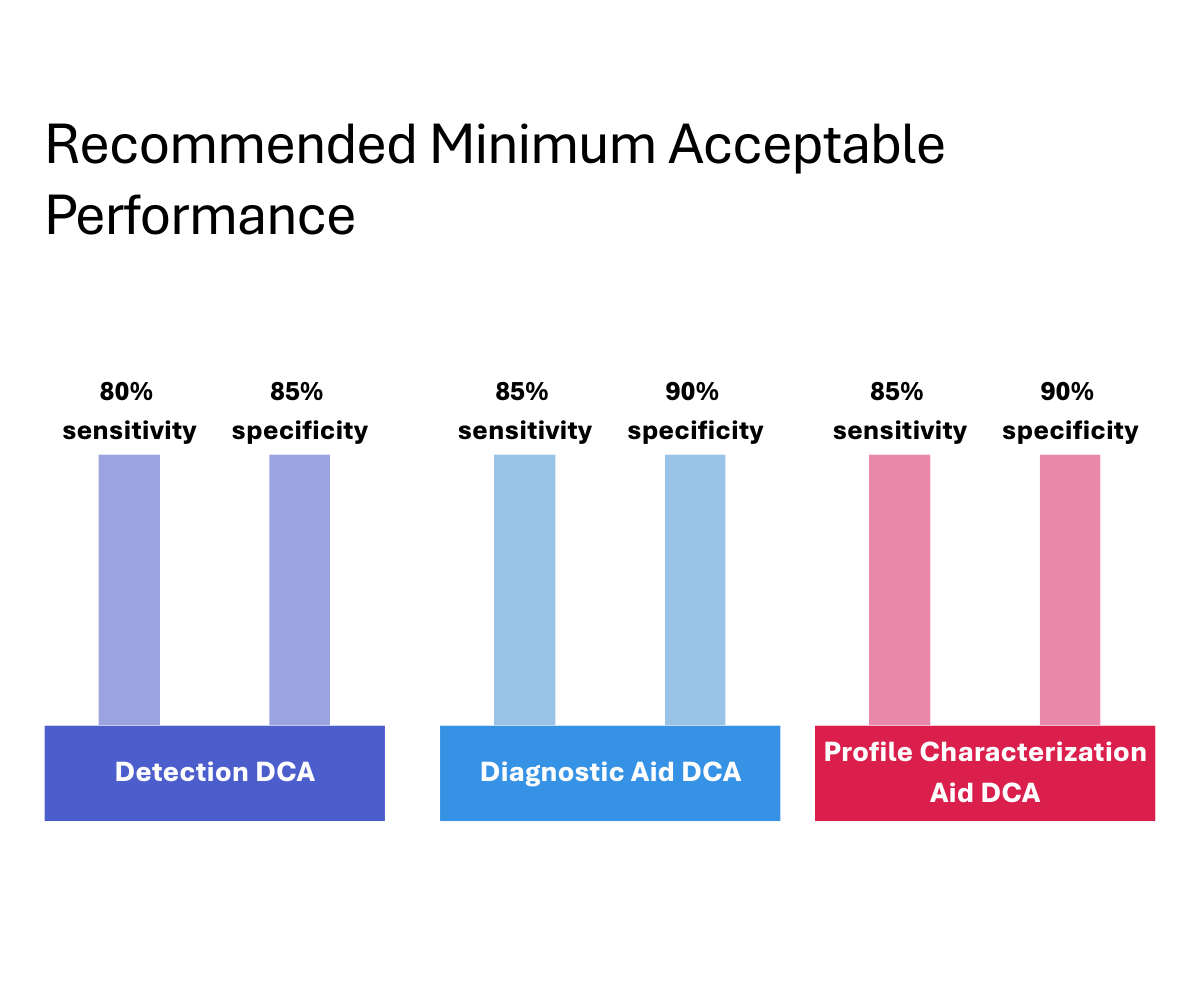
CEOi Test Characteristics and Performance Recommendations for In-Clinic DCAs
Key Takeaways from the Publication
The CEOi workgroup defined three primary clinical use cases for DCAs:
- Detection: DCAs to detect any possible cognitive impairment as an initial first step to gauge whether further evaluation is needed.
- Diagnostic Aid: DCAs to aid in the diagnosis of a cognitive syndrome (i.e., MCI or dementia) by providing an assessment tool that characterizes the degree of impairment.
- Profile Characterization Aid: DCAs to aid in differential considerations of underlying disease etiology by providing information on the cognitive profile.
DCAs should be validated against established neuropsychological test batteries and meet or exceed the performance of commonly used non-digital cognitive tools to ensure clinical reliability.
Read the Latest Diagnostic News and Insights
news web part will go here
Read the Latest
Diagnostic News and Insights
View More News & Insights Here
Comparative Survey Data (2024 and 2025): Clinician Awareness, Attitudes, and Interest in Blood Tests for Alzheimer’s Disease
Go To Resource
Roche’s Elecsys® pTau181 Becomes the Only FDA-Cleared Blood Test for Use in Primary Care to Rule Out Alzheimer’s-Related Amyloid Pathology
Go To Resource
Press & Media
Thank you to everyone who contributed to this effort:
- Core Team
- Louisa I. Thompson, PhD, Warren Alpert Medical School of Brown University
- Barak Gaster, MD, University of Washington School of Medicine
- Dustin B. Hammers, PhD, Indiana University School of Medicine
- Sol Fittipaldi, PhD, Latin American Brain Health Institute (BrainLat), Universidad Adolfo Ibáñez; Global Brain Health Institute, University of California, San Francisco; Trinity College Dublin; Centro de Neurociencias Cognitivas, Universidad de San Andrés
- A. M. Barrett, MD, University of Massachusetts Chan Medical School; UMass Memorial Health
- Katherine A. Partrick, PhD, The Global CEO Initiative on Alzheimer’s Disease
- Emily Scholler, MPH, The Global CEO Initiative on Alzheimer’s Disease
- Benjamin Tiede, PhD, The Global CEO Initiative on Alzheimer’s Disease
- Christopher R. Butler, PhD, The George Institute for Global Health; Imperial College London
- DCA Workgroup Members
- J. Wesson Ashford, PhD, VA Palo Alto Health Care System
- Sasha Bozeat, PhD, F. Hoffman–La Roche AG
- Kay Bhothinard, MBA, Eisai Inc
- David Berron, PhD, German Center for Neurodegenerative Diseases (DZNE), Magdeburg, Germany; Clinical Memory Research Unit, Department of Clinical Sciences Malmö, Lund University
- Soo Borson, MD, University of Southern California, Keck School of Medicine
- Bryan Cobb, PhD, Eisai Inc.
- Emrah Düzel, MD, University of Magdeburg; German Center for Neurodegenerative Diseases (DZNE); University College London
- Darren R. Gitelman, MD, Advocate Medical Group
- Ishtar Govia, PhD, Amagi Health Ltd
- Roos J. Jutten, PhD, Alzheimer Center Amsterdam
- Eric G. Klein, PharmD, Eli Lilly and Company
- Nicole A. Kochan, PhD, University of New South Wales
- Melissa Lee, PhD, Alzheimer’s Drug Discovery Foundation
- Nicklas Linz, PhD, ki:elements GmbH
- Tim MacLeod, PhD, Davos Alzheimer’s Collaborative
- Soeren Mattke, MD, University of Southern California
- Christopher J. Medberry, PhD, Johnson & Johnson
- Michelle M. Mielke, PhD, Wake Forest University School of Medicine
- Jennifer Murphy, PhD, Biogen
- Ziad Nasreddine, MD, MoCA Clinic and Institute
- Melissa E. Petersen, PhD, University of North Texas
- Andrew J. Saykin, PsyD, Indiana University School of Medicine
- Katherine J. Selzler, PhD, Davos Alzheimer’s Collaborative
- John Showalter, MD, Linus
- Dirk Smeets, PhD, Icometrix
- Christa M. Studzinski, PhD, Ontario Brain Institute
- Pierre N. Tariot, MD, Banner Alzheimer’s Institute
- Vivian Vasallo, MA, UsAgainstAlzheimer’s