
CEOi Recommendations for Clinical Implementation of Digital Cognitive Assessments
Published in Alzheimer's & Dementia
A Clear Roadmap to Integrate DCAs into Clinical Practice
To address this, CEOi convened stakeholders from healthcare, academia, non-profit, government, industry, and patient advocacy to develop practical recommendations for the clinical integration of DCAs, enabling a more timely and consistent diagnostic experience for patients across primary and specialty care.
Key Takeaways from the publication:
DCAs can be used in primary and specialty care settings to detect possible cognitive impairment, aid diagnosis, or provide detailed cognitive profile characterization depending on the clinical context and care setting.
Successful implementation requires multistakeholder collaboration to establish standardized workflow frameworks, expand workforce training, strengthen reimbursement pathways, and build real-world evidence for scalable adoption.
When used appropriately, DCAs provide a pathway for more robust and timely evaluations of cognitive impairment, helping to reduce diagnostic delays, unnecessary specialist referrals, and strain on limited healthcare resources.
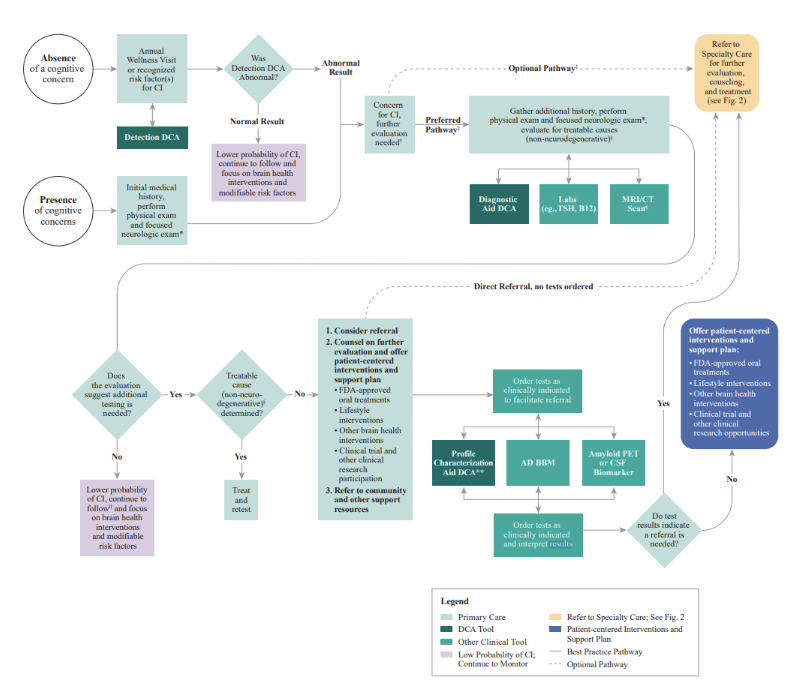
The primary care pathway (Figure 1) illustrates two entry points, whether a patient presents with cognitive concerns or is screened during an Annual Wellness Visit, and how DCAs integrate alongside labs, imaging, and blood based biomarkers. It guides clinicians through key decision points on evaluating treatable causes, offering brain health interventions and modifiable risk factor support, and determining when referral to specialty care is warranted.
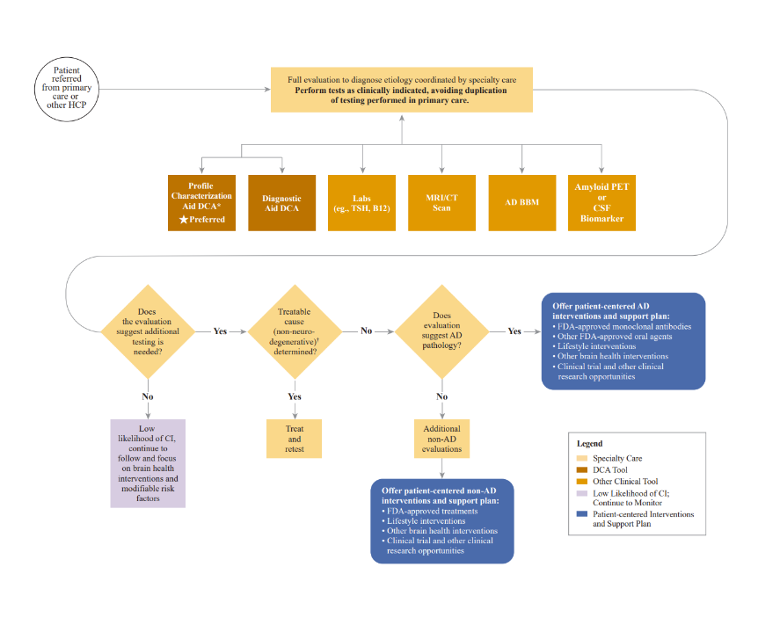
The specialty care pathway (Figure 2) depicts a coordinated full evaluation designed to avoid duplicating tests already performed in primary care, with the Profile Characterization Aid DCA identified as the preferred tool. It branches based on whether the evaluation suggests AD pathology, distinguishing patient centered pathways for AD interventions, including FDA approved monoclonal antibodies, from those for non-AD causes.
Read the Latest Diagnostic News and Insights
Read the Latest
Diagnostic News and Insights
Comparative Survey Data (2024 and 2025): Clinician Awareness, Attitudes, and Interest in Blood Tests for Alzheimer’s Disease
Roche’s Elecsys® pTau181 Becomes the Only FDA-Cleared Blood Test for Use in Primary Care to Rule Out Alzheimer’s-Related Amyloid Pathology
Press & Media
Thank you to everyone who contributed to this effort:
- Pierre N. Tariot
- Darren R. Gitelman
- Ishtar Govia
- Katherine A. Patrick
- Emily Scholler
- Melissa Petersen
- AM Barrett
- Chris Butler
- Barak Gaster
- Dustin Hammers
- Sol Fittipaldi
- Louisa Thomps